

How To Round Edges In Blender
How to gear up the radius for round shapes in Blender 2.8? (Spin)
One time you lot start working with Blender to create architectural models, you volition rapidly detect how fast you tin create geometrical shapes with tools like the extrude. The extrude is an easy and powerful style of making 3D geometry for compages, just it won't give y'all all the shapes needed for a typical project. In some cases, yous must go beyond simple extrudes to create 3D models.
For example, when you accept to create something like a curved extrude, yous volition have to look for a solution somewhere else. Does it make sense? Let me elaborate.
In Blender, you will detect options like the bend objects and the Spin tool to create rounded shapes. For architectural models, it is nigh probable to find a use for the Spin.
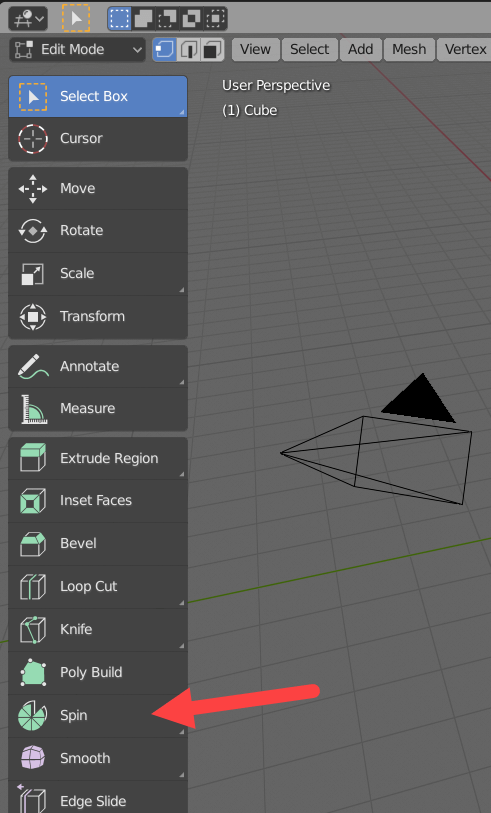
(Toolbar in Edit Mode)
The Spin works by taking any selected parts of a Mesh object and turn them effectually an axis. Every bit a reference, it uses the 3D Cursor as the pivot point for that plough.
For people coming from CAD tools, you volition be able to use the Spin equally if it was:
- Polar Array / Radial Array
- Curved extrude
- Revolved surface
Setting the radius for curved walls (Before using the Spin tool)
1 of the nigh straightforward examples regarding the Spin is a curved wall. A question that often appears with the Spin is; how to ready the radius for your curved wall?
To take control over that particular, we must utilise the Snap option with your 3D Cursor. We can take as an case the wall below.
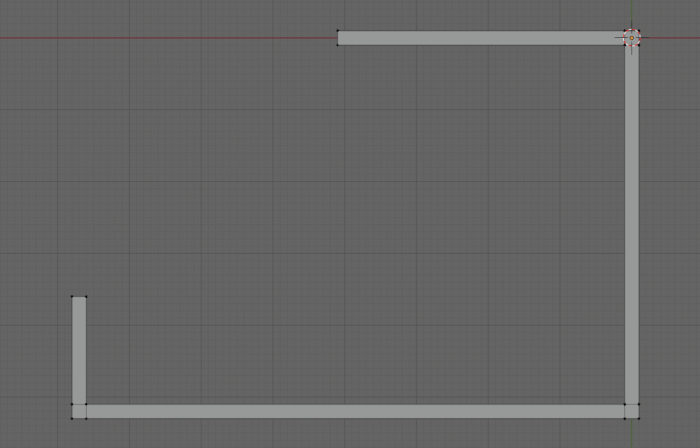
(Wall model – Summit view)
The first matter to practice here is fix a value for your radius. It could exist any value like ii meters, 7 feet, or any other y'all need. Regardless of the value, the procedure will be the same. For our example, we can apply iii.5 unites equally a length. Why? Like whatsoever CAD tool, nosotros can mensurate the distance betwixt each border of the walls.
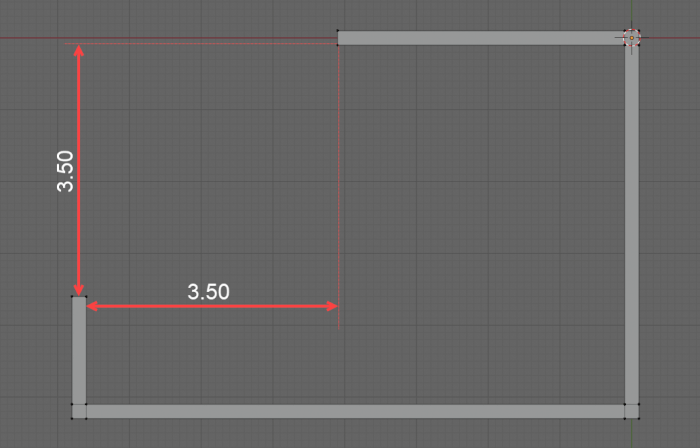
(Lengths)
With that value in mind, we can identify the 3D Cursor at a altitude of 3.5 units from the wall. Use the inner vertex from any of the wall end shapes. Select a vertex as the reference to moving your 3D Cursor. In Edit Mode, left click at any vertex.
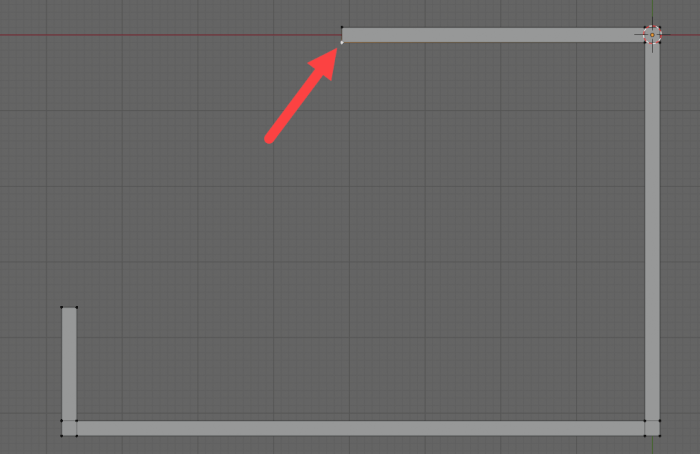
(Selected vertex from wall)
Press the SHIFT+S keys to phone call your Snap options and cull "Cursor to Selected." That volition make your 3D Cursor marshal with the vertex.
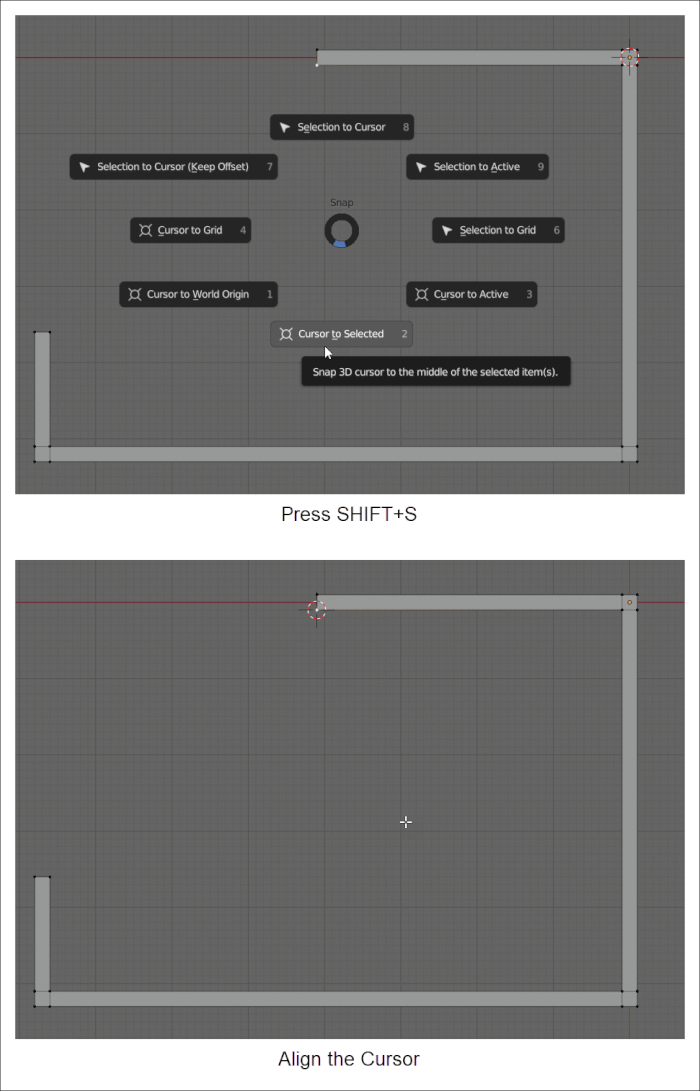
(3D Cursor aligned)
Moving the 3D Cursor with a precise value
The trick now is to place the 3D Cursor exactly 3.5 units abroad from our vertex, which volition set the radius distance for a Spin. By pressing the N key, we can open the Properties Sidebar and locate the View tab. In that location you find all coordinates for the 3D Cursor.
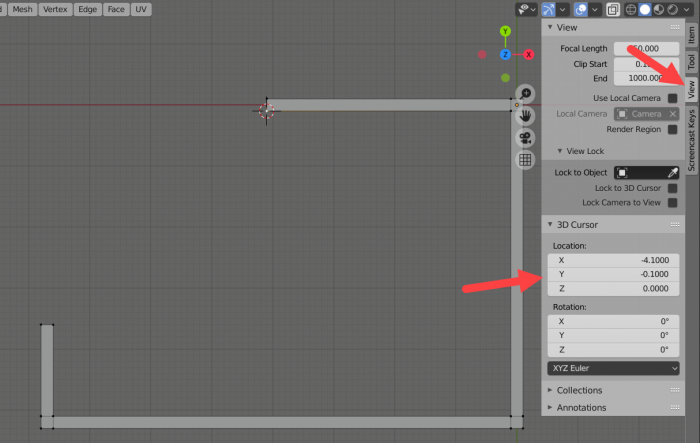
(3D Cursor coordinates)
Since we have to motion the 3D Cursor in the vertical axis, assuming yous are using the top view, we must change coordinates at the Y-axis. At the coordinates field, you can employ a simple expression to motion your Cursor 3.five units downwards. Click at the field and add "-3.v" to change your 3D Cursor location.
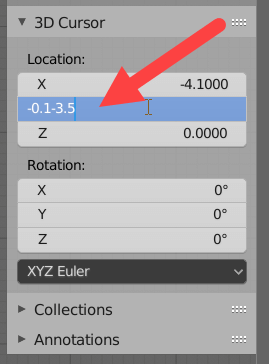
(3D Cursor coordinates)
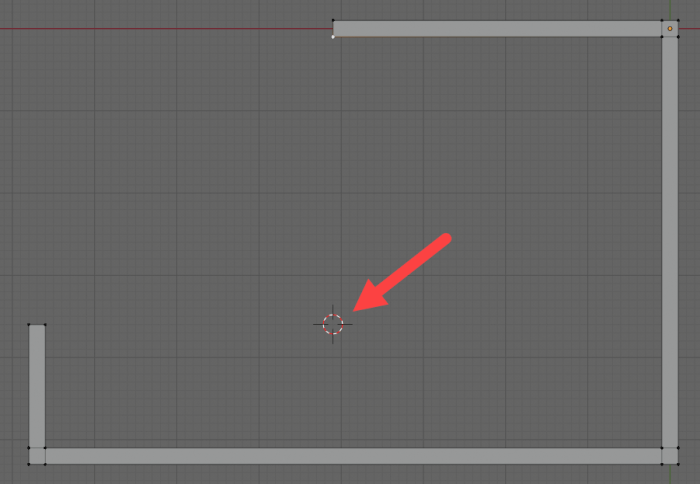 (3D Cursor location)
Starting the Spin: Creating a curved wall
The secret to creating whatsoever curved shapes with a Spin in Blender is to identify your 3D Cursor at the pin point and set your view to an orthographic projection (Numpad five). Another fundamental aspect of your Spin is that it happens in parallel to your view plane.
As a rule, you should e'er start the Spin from ane of the half-dozen orthographic views:
- Top (Numpad 7)
- Front (Numpad 1)
- Back (CTRL+Numpad 1)
- Correct (Numpad 3)
- Left (CTRL+Numpad iii)
- Bottom (CTRL+Numpad 7)
Using the Top view, you lot tin select the elements you wish to apply as a reference. In our instance, an edge is all we demand.
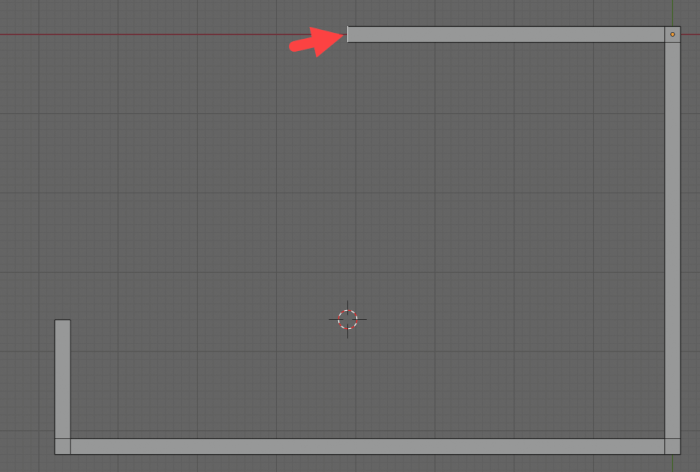
(Selected edge)
Printing the Spin button (Toolbar in Edit Style), and you will encounter a blue arc in a higher place your selected element. If you click and drag that arc, it volition start the Spin.
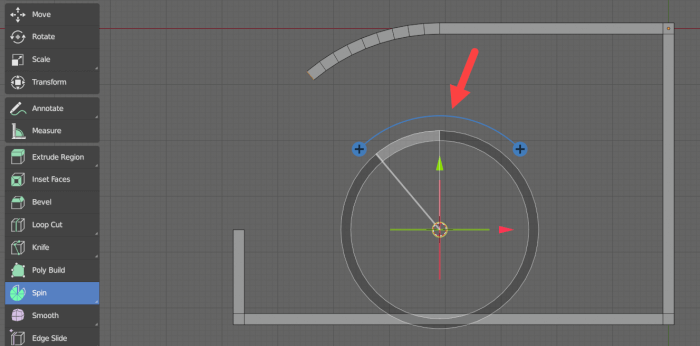
(Arc)
Notice how it is turning around the bespeak set past your 3D Cursor. Using the mouse to control your curved wall might non exist the all-time solution for precision. At the lower-left corner, you will see the floating card with options regarding your Spin.
Change the values with:
- Angle: Set the length and direction of your curved shape. The length uses degrees and a positive or negative value for guidance.
- Steps: Since nosotros are using polygons for modeling and not curves, you lot must gear up the number of divisions for that circular shape. Values between 12–24 normally are enough for curved shapes.
Here is the curved wall.
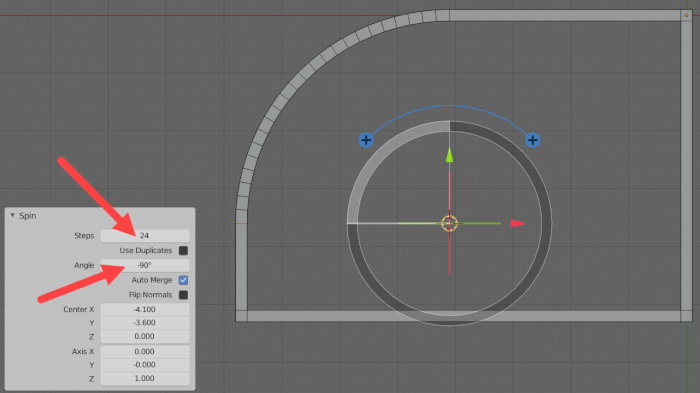
(Curved wall)
Here are a few things y'all should consider when using the Spin:
- Start by defining the radius length
- Pick an existing reference indicate and marshal information technology to the 3D Cursor
- You can kickoff a Spin using the mouse and go precise control with the floating card on the lower-left corner
- Always trigger the Spin using an orthographic view parallel to the viewing aeroplane
- The process besides works when you lot take a unit organisation, which will brand yous type lengths as meters/centimeters or anxiety/inches
Using Blender for compages
Exercise you desire to use Blender for architecture or return your projects using Cycles or Eevee? We have three books bachelor that could help you!
They cover the use of Blender for producing architectural content and also all information you lot need to render projects in existent-time:
- Blender 2.9 for compages: Modeling and rendering with Eevee and Cycles
- Blender two.8 parametric modeling: Drivers, Custom Properties, and Shape Keys for 3D modeling
- Blender 3.0: The beginner's guide
- Blender ii.8 for technical drawing
- Blender Eevee: The guide to real-time rendering with Blender 2.eight
You lot tin get them in both digital and paperback formats. By ordering those books, you volition non simply better your skills with Blender for architecture merely also back up Blender 3D Builder.
Source: https://www.blender3darchitect.com/modeling-for-architecture/how-to-set-the-radius-for-round-shapes-in-blender-2-8-spin/
0 Response to "How To Round Edges In Blender"
Post a Comment